
This evaluation report examines Dutch policy on contributing manpower and resources to the security and defence efforts of the EU and NATO to protect national security. How do the Netherlands ensure that these organisations contribute to Dutch security? And what do the Netherlands do to contribute?
IOB evaluated Dutch foreign and security policy regarding NATO and the EU for the period 2020-2024. In particular, the following was researched:
- efforts to counter hybrid threats
- the strengthening of the defence industry
- contributions to military missions and readiness
Background

NATO has been the cornerstone of the military defense of Dutch territory against foreign threats for decades. In addition, in the past twenty years the EU has been playing an increasingly bigger role in the field of security and defense. The EU has therefore explicitly become an actor in Dutch security policy. In 2020 the Dutch government formalized this in a dual-track approach to NATO and the EU: it wanted to strengthen both NATO and the EU in the interest of Dutch security. The starting point is that the two organisations can also strengthen each other.
Main question
What conclusions can be drawn about the effectiveness of Dutch security policy regarding NATO, the EU and efforts to improve the coherence between NATO and the EU between 2020-2024 and what lessons can be learned for future policy?
Conclusions

Main conclusion:
During the period under review, the Netherlands’ engagement in NATO and the EU has contributed to the country’s security. The diplomatic efforts and the knowledge, manpower and resources provided by the Netherlands have strengthened NATO and the EU. However, opportunities are still being missed. During the period under review, the Netherlands lacked a clear guiding strategy to inform decision-making on its NATO and EU commitments.
The main conclusion is further elaborated in the study in the four sub-conclusions summarised here:
- The Dutch commitment to NATO and the EU contributed to the security of the Netherlands during the period under review. However, in an unstable geopolitical context, continuous effort is required to strengthen NATO and the EU in line with Dutch interests.
- During the period under review, the Dutch government did not develop a guiding strategy to shape the division of roles and responsibilities between NATO and the EU, nor to enhance their complementarity, on the basis of which our country could determine distinct priorities and commitments for each organisation.
- The Netherlands' diplomatic efforts within NATO and the EU are generally effective, but there are opportunities to exert more influence.
- The Netherlands constructively contributes knowledge, manpower and resources to strengthen EU and NATO security policy, but some opportunities are being missed.
Recommendations

Based on the findings IOB presents the following five recommendations, which are further elaborated in the report:
- Define strategic priorities for engagement in the EU and NATO, particularly in light of recent geopolitical developments in the transatlantic relationship.
- Commit to a more substantial European role in European security, with independent operational capacity and a European pillar within NATO.
- Develop a constructive vision for EU-NATO cooperation and complementarity and engage in dialogue with other Member States.
- Build coalitions and partnerships to advance security policy, not only within the EU and NATO but also with countries such as the United Kingdom, Turkey, Switzerland, Austria and Canada.
- Establish clear working guidelines for the Dutch position in the EU and NATO.
- Assign double-hatted staff from the Permanent Representations of the EU and NATO to work on the same issues in both settings.
- Provide more substantial top-down guidance to encourage knowledge exchange between policy officers across ministries and between The Hague and Brussels.
- Develop an action plan for strategic secondment for key positions in the EU and NATO, aligned with a broader guiding strategy.
- Ensure that Dutch ambitions on hybrid threats, the defence industry, and military missions are better aligned with actual contributions in the EU and NATO contexts.
- In addition to committing to increased defence spending, make a clear commitment to increase European defence cooperation.
- Improve alignment between the NATO planning process and European defence investments to develop an assertive European pillar within NATO.
- Advocate for European legislation establishing NATO military equipment and ammunition standards.
- Continue efforts to improve information sharing between the European Defence Agency and the NATO Support and Procurement Agency.
- Develop joint defence projects with like-minded countries, including the production of critical enablers on European soil.
- Explore ways for European defence spending to be counted towards NATO’s investment benchmark.
- Hybrid threats and foreign interference remain persistent challenges. Therefore, in addition to investing in military defence and deterrence, continue efforts to strengthen the resilience of governments and societies.
- Improve coordination between EU and NATO efforts to enhance resilience and counter hybrid threats.
- Where possible, provide more concrete cases for joint responses in the EU and NATO context.
- Improve inter-service cooperation on international engagement related to hybrid threats and resilience.
- Continue to use the independent Hybrid Centre of Excellence in Helsinki and the NATO Cyber Centre of Excellence in Tallinn as platforms for cooperation.
- Support a structured transition towards greater European responsibility for Europe’s security, including the development of a European pillar within NATO.
- Deepen and expand engagement in the EU context.
- Prevent duplication of commitments to rapid reaction forces.
Contact person
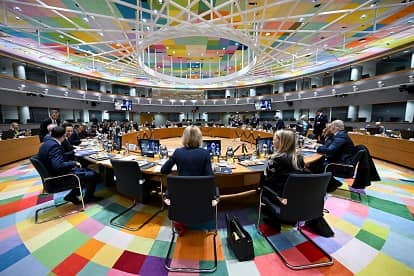
High Representative Kallas at the European Council 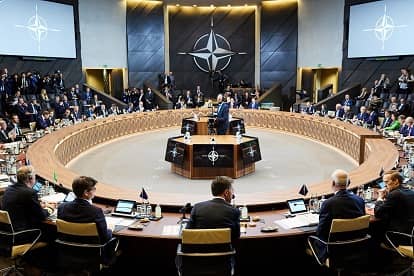
North Atlantic Council meeting on October 17, 2024 in Brussels